
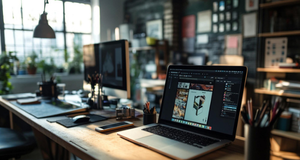
3D modeling turns an idea into something you can see, rotate and refine long before anything is produced. For brands, it is the fastest way to test how a product, packaging or scene will feel in the real world without committing to expensive photography or manufacturing.
We love to bring designs to life, and we aim to do this using whatever tools are best for the job. Our preferred pipeline is modern and node-based, but the principles stay the same no matter the software.
Start with the story, not the mesh
Before we touch a single vertex we agree on what the model needs to communicate. A hero product shot has very different requirements from an explainer animation, and knowing the end use keeps the geometry lean.
We block out the silhouette first, review it as a team, and only then add detail where the camera will actually see it. Everything else stays low-poly.
A repeatable pipeline
Consistency comes from a checklist everyone follows. Ours looks roughly like this:
- Block out the silhouette and camera
- Add supporting detail where it reads
- Build reusable materials, not one-offs
- Light for mood, then for clarity
- Render, review, and version
Materials do the heavy lifting
A simple shape with the right material reads better than a complex mesh with a flat surface. We build a small library of reusable materials so every project stays consistent and fast to iterate.
Great results start with clear strategy and clean design. We plan carefully so every project performs.
Wolphix Design Team
The result is a pipeline that is repeatable, editable and ready to grow with the brand.

0 Comments
Leave a comment